
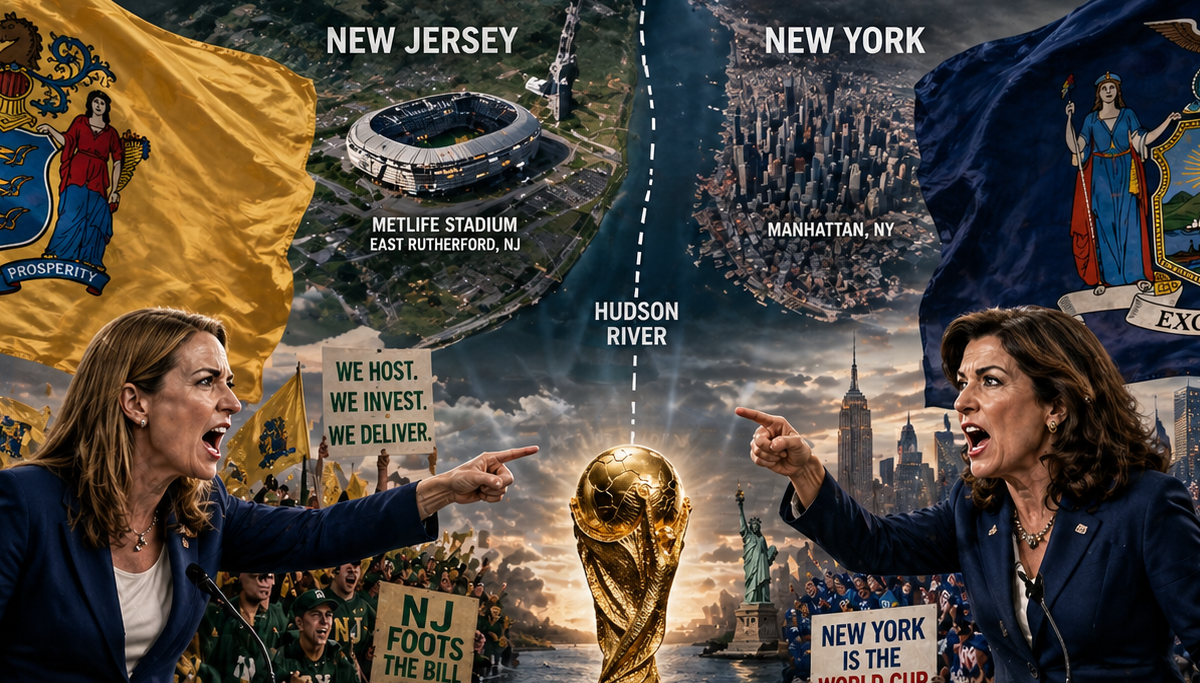
Hochul’s “New York Is the World Cup” Remark Fuels Tension as New Jersey Shoulders Hosting Burden
EAST RUTHERFORD, NJ – After New Jersey Governor Mikie Sherill launched a verbal volley across the Hudson last week regarding the cost of hosting the 2026 FIFA World Cup in her state and the growing costs, despite New York getting all the credit, Governor Kathy Hochul has fired back.
“New York is the World Cup,” Hochul said, dismissing Governor Sherrill’s claims to the event and grumblings over transportation costs.
The growing dispute between New York and New Jersey is beginning to overshadow preparations for the 2026 FIFA World Cup, as political leaders on both sides of the Hudson River stake competing claims over one of the world’s largest sporting events.
The friction intensified after New York Governor Kathy Hochul delivered a sweeping, emotionally charged statement celebrating New York City’s global diversity and its connection to the tournament. “No better place on this planet than to be watching the World Cup than here in New York City,” Hochul said. “So I want to say New York isn’t just hosting the World Cup. New York is the World Cup.” The remarks, clearly intended to highlight the city’s international communities and fan culture, have nevertheless struck a nerve in neighboring New Jersey.
The issue is straightforward but politically sensitive. While FIFA markets the region as “New York/New Jersey,” every actual match tied to that designation will be played at MetLife Stadium in East Rutherford, New Jersey. The stadium is set to host multiple games, including the World Cup Final, placing New Jersey at the center of the tournament’s most high-profile moments.
That reality has fueled frustration among New Jersey officials, who argue that the state is carrying the logistical and financial weight of hosting while New York reaps the branding benefits. Acting New Jersey Governor Mikie Sherrill has been particularly vocal about the imbalance, pushing back against the idea that Garden State taxpayers should be left footing the bill. Sherrill has called on FIFA and event organizers to cover key costs tied to transportation and infrastructure, warning that New Jersey should not be expected to subsidize a multi-billion-dollar global event without appropriate support.
Behind the scenes, New Jersey is investing heavily in preparations, from transit upgrades to security planning and stadium improvements. Officials have also raised concerns about the cost burden on fans, including sharply increased transportation fares tied to game-day travel. Those issues have added another layer of tension, as state leaders seek to balance economic opportunity with public backlash over rising costs.
Meanwhile, New York has leaned into its role as the cultural epicenter of the region, planning large-scale fan experiences, watch parties, and tourism initiatives across New York City. While those efforts are expected to generate significant economic activity, they also reinforce the perception that New York is positioning itself as the face of the World Cup, despite not hosting any matches within its borders.
The dynamic reflects a broader reality of the New York metropolitan area, where branding and geography often diverge. Global events frequently attach themselves to the “New York” name for its international recognition, even when venues sit across state lines. But with the World Cup’s scale and visibility, that long-standing practice is now drawing sharper scrutiny.
As the countdown to 2026 continues, both states remain essential partners in delivering the tournament. Still, Hochul’s declaration that “New York is the World Cup” has crystallized an underlying tension—one that raises a familiar question in the region: when it comes to global attention, who gets the credit, and who pays the price?